Showing posts with label Theory. Show all posts

Wednesday, February 18, 2009

Big Box Reuse


By Julia Christensen
Publisher: The MIT Press
Number Of Pages: 220
Publication Date: 2008-11-30
ISBN-10 / ASIN: 0262033798
ISBN-13 / EAN: 9780262033794

Book Description:
America is becoming a container landscape of big boxes connected
by highways. When a big box store upsizes to an even bigger box
"supercenter" down the road, it leaves behind more than the vacant
shell of a retail operation; it leaves behind a changed landscape
that can't be changed back. Acres of land have been paved around
it. Highway exits lead to it; local roads end at it. With
thousands of empty big box stores spread across America, these
sites have become a dominant feature of the American landscape.
In Big Box Reuse, Julia Christensen shows us how ten communities
have addressed this problem, turning vacated Wal-Marts and Kmarts
into something else: a church, a library, a school, a medical
center, a courthouse, a recreation center, a museum, and other
civic-minded structures. In each case, what was once a place to
shop has become a center of community life.
Christensen crisscrossed America identifying these projects, then
photographed, videotaped, and interviewed the people involved. The
first-person accounts and color photographs of Big Box Reuse reveal
the hidden stories behind the transformation of these facades into
gateways of community life. Whether a big box store becomes a
"Senior Resource Center" or a museum devoted to Spam (the kind that
comes in a can), each renovation displays a community's
resourcefulness and creativity—but it also raises questions about
how big box buildings affect the lives of communities. What does it
mean for us and for the future of America if the spaces of commerce
built by a few monolithic corporations become the sites where
education, medicine, religion, and culture are dispensed wholesale
to the populace?.

Easyshare | 9,9 MB

Wednesday, January 14, 2009

Fire Safety Engineering


John A Purkiss, "Fire Safety Engineering"

Butterworth-Heinemann | 2006-12-07 | ISBN: 0750664436 | 424 pages | PDF | 2,1 MB

Fire Safety Engineering: Design of Structures provides the knowledge needed to design a structure which will withstand the effects of fire.
The book covers everything from design concerns and philosophies, regulatory control, the behaviour characteristics of natural fires through to the properties of different materials at elevated temperatures.
Focusing on the fire sections of the Structural Eurocodes, the book provides detailed design advice on each of the main structural elements such as concrete, steel, composite steel-concrete, timber, and masonry, aluminium, plastics and glass.

J. A Purkiss, Consultant, previously lectured Structural Engineering at Aston University. His main areas of research were the behaviour of concrete, concrete composite materials and concrete structures at elevated temperatures, the experimental determination of the effects of spalling and its modelling using coupled heat and mass transfer, the determination of the characteristics of fire damaged concrete structures.

* Design methods based on the fire sections of the new Structural Eurocodes
* Worked calculations and examples clearly illustrate the effect of temperature rise and structural performance of structural elements
* Essential reading for Structural Engineers, Building Designers, Architects, Fire Engineers and Building Control Officers

Rapidshare

Tuesday, December 9, 2008

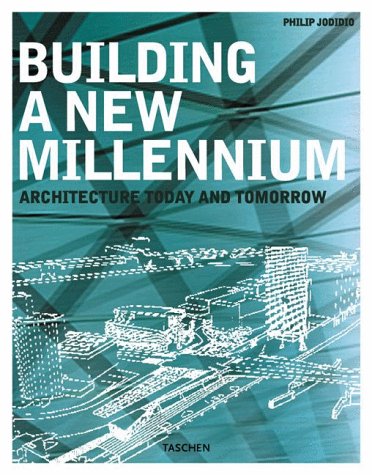
Building a New Millennium: Bauen Im Neuen Jahrtausend, Construire UN Nouveau Millenaire (Specials)


By Philip Jodidio

Publisher: Taschen

Number Of Pages: 576

Publication Date: 1999-10

ISBN-10 / ASIN: 3822863904
ISBN-13 / EAN: 9783822863909
Binding: Paperback


Book Description

The earth seems smaller after reading this ambitious book. Its aim: to present the world's most exciting new buildings as humanity enters the new millennium. The book illustrates and analyzes more than 80 projects by 50 well-known architects. While acknowledging the existence of local styles, Philip Jodidio--editor of a prestigious French art journal--emphasizes the global nature of architecture today. The selection of buildings here is truly multicultural, from the new Hong Kong airport and Kyoto's train station to daringly designed homes, schools, museums, even contrasting styles of crematoria (one each from Germany and Japan). With new "space age" materials and very large sums of public and private money, today's architects experiment in creating innovative spaces in which cultural, religious, and other more mundane events can be experienced. The buildings often seem ends in themselves: a $10 million museum in Seoul houses just two Rodin sculptures in a light-filled, inspirational environment; the Jewish Museum in Berlin deliberately opened empty, with no collection of any sort, the dark, jagged architecture sending its own message. The book's international flavor is enhanced by the practice of the publisher, Taschen, to offer text in three languages: English, German, and French. This presents design difficulties that are handled well, with text boxes, alternating triple columns, and restful light-blue "breathing spaces." Descriptions of the buildings are succinct and informative, the photographs of high quality. Building a New Millennium is a successful portrait of the state of architecture at this moment in our accelerating global culture. --John Stevenson

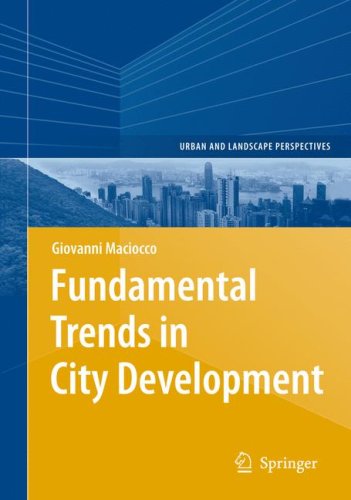
Fundamental Trends in City Development (Urban and Landscape Perspectives) (Urban and Landscape Perspectives)


Fundamental Trends in City Development (Urban and Landscape Perspectives)
By Giovanni Maciocco

  • Publisher: Springer
  • Number Of Pages: 220
  • Publication Date: 2008-02-25
  • ISBN-10 / ASIN: 354074178X
  • ISBN-13 / EAN: 9783540741787
  • Binding: Hardcover
What do phenomena like sprawl, generic city or urban segregation have in common with the concept of the city? This is not an easy question. It is nevertheless the inquiry this book is based on, mainly because of the bewilderment we feel when faced with these phenomena that are spread throughout the urban world and constitute a tall order for our concepts of the city. Expressions like discomposed city, generic city and segregated city refer to entities that share the loss of the city as a space of communication and social interaction and as the space of the public sphere.

In order to explore what we call the city adrift, certain positions of scholars of the city are analysed, using the utopia as an analytical category and referring to three kinds the conservative utopia, liquidatory utopia and resistant utopia which can perhaps significantly distinguish the different positions on current spatial trends of the city and, more generally, the phenomena emerging in the urban world.

This book investigates how the city can be re-established as the space of dialogue and communication, how the spatial conditions of the public sphere can be created and the city retrieved, and what the features might be of a city retrieved and restored to its citizens.

The author adopts the concept of externity as an innovative element for the project for the city, a constituent feature of all those situations traditionally considered non-functional, therefore external, to our contemporary post-cities, which are consigned to us adrift through decomposition, genericity and segregation.

Rapidshare / 3MB